
Right of Way Compensation Must Be Updated: Constitutional Court Rules on Property Rights
Turkey’s Constitutional Court has ruled that a landowner’s property rights were violated when the right of way compensation in a case lasting nearly seven years was calculated using the outdated value from the date the lawsuit was filed. The decision on the application by Saner Ergili (Application No: 2020/22340), dated 5 May 2026, was published in the Official Gazette (Resmî Gazete) on 4 November 2026, issue no. 33420. The ruling brings much-needed clarity to a question that frequently arises for owners of landlocked plots — and for neighbours forced to grant access across their land: when a case drags on for years, which date should determine how much is paid for a right of way?
What Is a Right of Way, and Who Can Claim One?
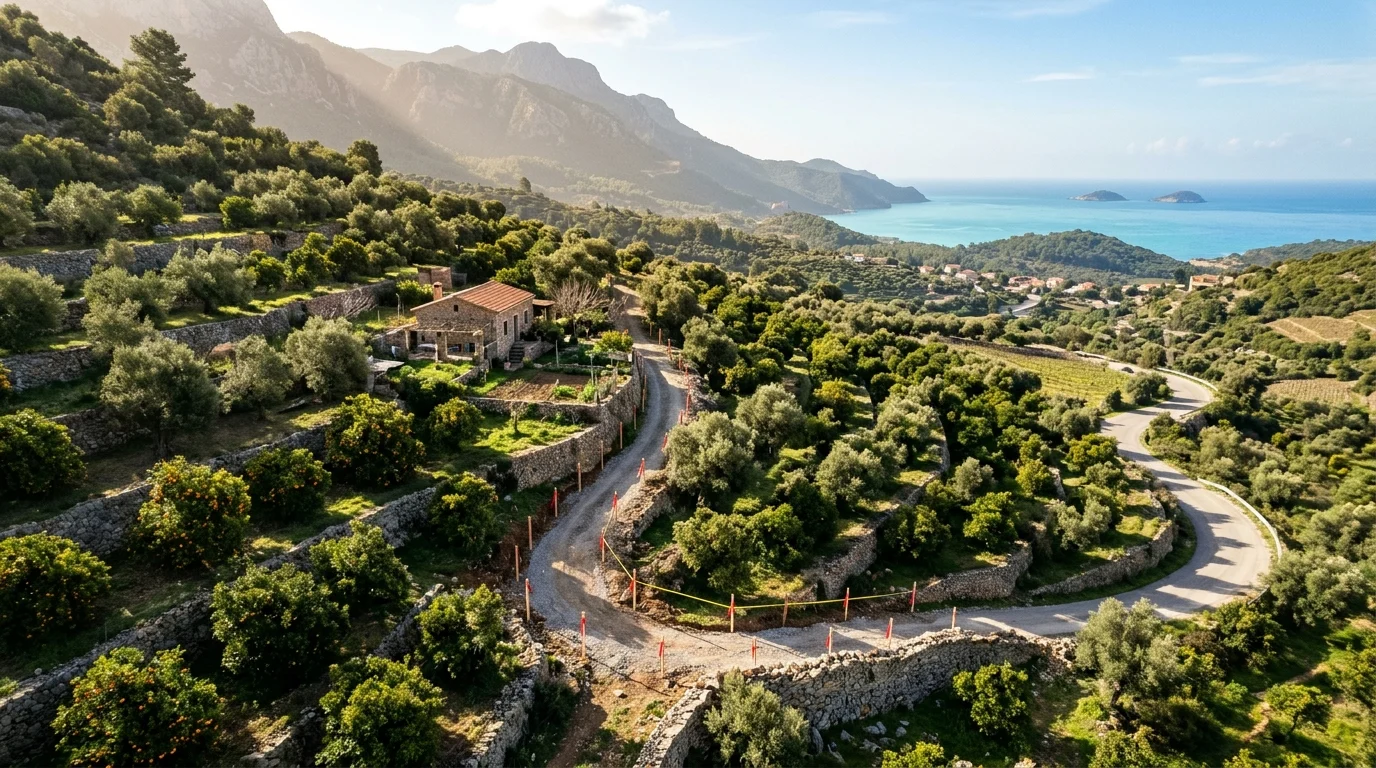
Under Article 747 of the Turkish Civil Code (TMK), a landowner whose property has no adequate access to a public road can apply to the court to have a right of way established over a neighbouring plot, in exchange for full compensation. This right takes the form of an easement (irtifak hakkı) registered against the neighbouring title deed (TAPU). When deciding on the route, the court does not simply pick the shortest path — it weighs up which option causes the least disruption and best balances the interests of both parties. In Alanya’s rural districts, in gardens and orchards set back from mountain roads, and on agricultural land where planning processes are still incomplete, these cases come up regularly.
The Case Before the Constitutional Court
The dispute concerned a plot in Çeşme, İzmir, located within a first-degree protected natural heritage area. The owner of the neighbouring land, needing access to a public road, filed a right of way lawsuit at the Çeşme Civil Court of Peace (Sulh Hukuk Mahkemesi) on 12 January 2010. Court-appointed expert reports concluded that the most suitable route ran across the applicant’s property.
| Date | Development |
|---|---|
| 12.01.2010 | Right of way lawsuit filed. |
| 01.03.2011 | Court-appointed expert valued the land at TL 20 per m², putting the total compensation at TL 2,604.40. |
| 2014 | A site inspection put the value at TL 30 per m²; compensation was then adjusted back to the date of filing, giving a figure of TL 4,169.98. |
| 24.07.2014 | Court approved the right of way at this level of compensation. |
| 19.04.2016 | Court of Cassation (Yargıtay) quashed the decision because no opinion had been obtained from the heritage protection board regarding the protected-area status. |
| 16.11.2016 | Court re-approved the right of way at the same compensation figure. |
| 17.02.2020 | Court of Cassation upheld the decision with a minor amendment; the ruling became final. |
Almost six years and ten months passed between the date the lawsuit was filed and the final decision — yet the compensation was never updated. The applicant argued that per-square-metre values in the area had risen substantially, and lodged an individual application with the Constitutional Court.
Why Did the Compensation Need Updating?
Because this was a dispute between two private individuals, the Constitutional Court’s Second Section examined the case through the lens of the state’s positive obligations under Article 35 of the Turkish Constitution, which protects property rights. The Court accepted that Article 747 of the Turkish Civil Code (TMK) and the existing Court of Cassation case law provided a sufficiently clear and foreseeable legal basis for the right of way itself — the problem lay in how the compensation had been assessed.
The ruling referred to decisions of the Court of Cassation’s Civil General Assembly and its 14th and 7th Civil Chambers. According to that case law, right of way compensation must be determined by a court-appointed expert using objective criteria and deposited with the court before judgment is given. If the proceedings have been lengthy and the value of the land has changed significantly, a fresh valuation close to the date of judgment is required.
In this particular case, the Court found that even between the 2014 site inspection and the filing date, the per-square-metre value had already risen by approximately 42%. Despite this, the compensation was left unchanged — placing an “individual and excessive burden” on the applicant. Because the fair balance between the neighbouring claimant’s interests and the applicant’s property rights had been broken, the Court unanimously found a violation of the right to property.
Outcomes of the Decision
- The case was sent back to the Çeşme Civil Court of Peace (Sulh Hukuk Mahkemesi) for a retrial to remedy the violation.
- The applicant’s claim for TL 130,000 (approx. £1,950 / €2,330 — depending on current exchange rates) in compensation was rejected on the basis that a retrial would itself provide adequate redress.
- The court ordered payment to the applicant of TL 40,446.90 in costs, made up of a court fee of TL 446.90 and legal costs of TL 40,000.
- The complaint that the deposited compensation had lost value due to inflation was not examined separately, as the violation had already been established.
Practical Implications for Those Involved in Right of Way Cases
This ruling is a clear reminder that right of way compensation is not frozen at the value that applied on the day the lawsuit was issued. If you own a plot over which a right of way is being sought, and the case has gone on for years, you can ask the court to commission a fresh valuation close to the date of judgment — particularly in areas where land values move quickly.
If you are the party seeking the right of way, bear in mind that a long-running case may mean higher compensation by the time judgment is given. It is worth keeping a close eye on interim court orders concerning the deposit of compensation and any updated valuation exercises.
A few practical points worth noting:
- Route selection: The court is not simply looking for the shortest route — it looks for the one that causes the least harm and best balances the interests of both sides. You can request that the court-appointed expert assess alternative routes.
- What compensation covers: The figure is not limited to the value of the land itself — it can include losses arising from items that need to be removed, such as trees or fencing.
- Lengthy proceedings: If the case has been delayed by an appeal or additional expert reports, do not overlook your right to request a fresh valuation before judgment is given.
- Specially protected areas: On land within a heritage protection zone, forest, or conservation area, failure to obtain the required opinion from the relevant authority can lead to the decision being quashed — exactly as happened in the Çeşme case.
The question of which date and which value should be used to assess land compensation is not unique to right of way cases — it comes up just as often in debates about compulsory purchase (expropriation) compensation. Another recent Constitutional Court decision on property rights addresses the market value rule in pre-emption (right of first refusal) cases.
Individual Applications and Retrials
Once all ordinary appeal routes have been exhausted, anyone who believes their property rights have been violated can lodge an individual application with the Constitutional Court within 30 days of learning of the final decision, under Article 47 of Law No. 6216. If a violation is found, Article 50 of the same law requires the file to be sent back to the relevant court for a retrial aimed at eliminating the violation and its consequences — broadly similar to the way a successful appeal to the European Court of Human Rights can trigger domestic proceedings.
In the Çeşme case, the expectation is that on retrial the court will reassess the right of way compensation against current values. Although the Constitutional Court’s decision applies only to this specific case, it provides clear guidance on how compensation should be determined in lengthy right of way proceedings.
This article is for general information purposes only and does not constitute legal advice. You should refer to current legislation and official announcements for your specific situation.
Frequently Asked Questions
Answers to the questions on your mind