
Inherited Property in Turkey: New Heirs-Only Auction Rule
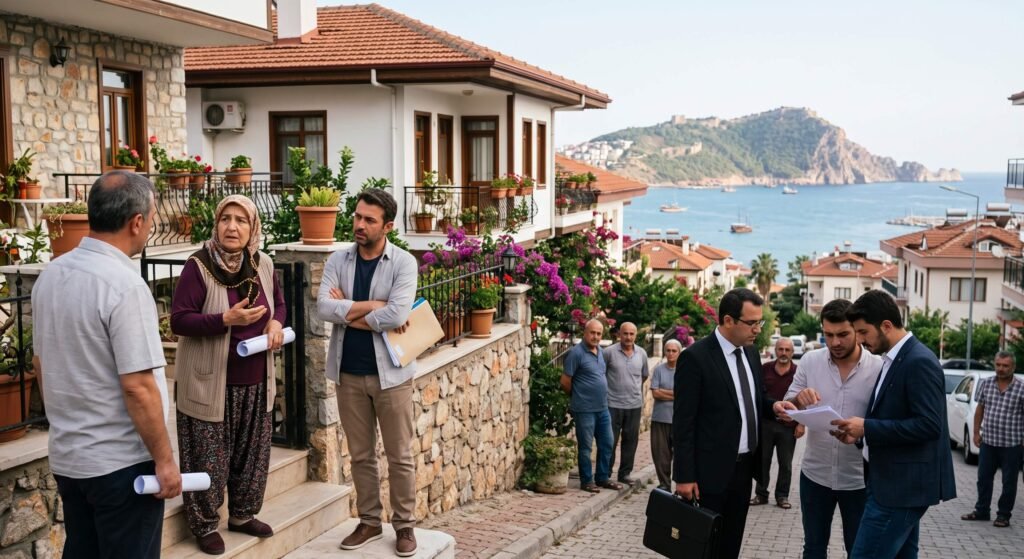
Turkey’s 12th Judicial Package (Law No. 7589) changes how inherited real estate is sold when heirs cannot agree. Here is what foreign property owners and heirs living abroad need to know.
Alanya is home to thousands of foreign property owners, many of whom bought apartments and villas here years ago. As time passes, a growing number of these properties are being passed on to children and relatives, often living in different countries. When heirs cannot agree on what to do with an inherited home, Turkish law offers one route: a court case to end the co-ownership, known as ortaklığın giderilmesi or, traditionally, izale-i şuyu.
On 31 July 2026, a significant reform to this process came into force. Here is what changed and why it matters to you.
What Is an “Izale-i Şuyu” Case?
When a property owner dies, their heirs automatically become joint owners of the property. Under Turkish law, jointly owned property can only be sold, rented or managed with the agreement of all owners. If even one heir refuses, the property is effectively frozen.
Any heir can then ask the Civil Court of Peace (Sulh Hukuk Mahkemesi) where the property is located to end the co-ownership. If the property cannot be physically divided, which is almost always the case with apartments and villas, the court orders it sold at public auction and divides the proceeds among the heirs according to their shares.
These cases can be slow. Every heir must be a party, and when heirs live abroad, serving court documents, obtaining translations and certifying powers of attorney can add months or even years to the process.
The Old Problem: Family Homes Sold at Half Price
Until recently, the auction was open to the public from the start, and the first bid could begin at 50% of the property’s court-appointed value. A villa valued at 10 million TL could be sold to a professional auction buyer for 5 million TL, meaning every heir received far less than their share was really worth.
Heirs living abroad were at a particular disadvantage. Following online auction announcements in Turkish, arranging a deposit and bidding in time was often impossible from another country.
What Has Changed Under Law No. 7589
The reform amended Article 114 of the Turkish Enforcement and Bankruptcy Law (İcra ve İflas Kanunu). The key changes are these.
The first auction is now closed to outsiders. Where all owners acquired the property through inheritance and no non-heir owns a share, the first auction is held only among the heirs themselves. The law makes no distinction based on nationality, so a foreign heir who is a registered owner has the same right to take part as a Turkish heir.
The first auction starts at full value. Bids in the heirs-only auction must cover 100% of the court-appointed value plus sale costs. The property can no longer be sold below its value in the first round.
It applies only once. If no heir makes a valid bid, the second auction is open to everyone and may again start at 50% of the value.
Heirs must now pay a deposit. Previously, co-owners were exempt from the auction deposit in proportion to their share. This exemption has been removed, so heirs must provide a deposit just like any other bidder.
Penalties for failed bids. A winning bidder who does not pay loses the deposit and faces an administrative fine of 5% of the bid amount. This targets bidders who made unrealistic offers simply to delay the sale.
Timing matters. The new rules do not apply to auctions announced before the law came into force. What counts is the date of the sale announcement, not the date the case was filed.
Are Family Properties Now Fully Protected?
Better protected, but not guaranteed. The heirs-only auction is only useful if at least one heir can pay the full value of the property. If nobody can, the property goes to an open auction in the second round.
The rule also does not apply if any share has ever been sold or gifted to someone outside the family. If, for example, one heir has already sold their share to a third party, the special procedure is lost and the sale is open to the public from the start.
For heirs abroad, the practical message is clear: if you want to keep the property, you need financing ready before the auction is announced, and someone in Turkey who can act for you quickly.
Issues Specific to Foreign Owners and Heirs
Which law applies? Under Turkish private international law, inheritance is generally governed by the deceased’s national law, but for real estate located in Turkey, Turkish law applies. This means Turkish rules on who inherits and in what shares will usually govern your property in Alanya, even if the deceased was a foreign national with a will made abroad.
Certificate of inheritance. The Turkish Land Registry generally requires a Turkish certificate of inheritance (mirasçılık belgesi or veraset ilamı), obtained from a Turkish court or notary. Foreign probate documents usually cannot be used directly and may need translation, apostille and, in some cases, formal recognition.
Restrictions on foreign ownership. Foreigners can inherit property in Turkey, but acquisitions remain subject to the general rules on foreign ownership, including reciprocity and restrictions in certain zones. In rare cases, a foreign heir may be required to transfer the property rather than keep it. Checking this early avoids surprises.
Inheritance tax. Heirs must file an inheritance tax return in Turkey within legal deadlines, which differ depending on where the deceased and the heirs lived. Missed deadlines lead to penalties.
Power of attorney. A power of attorney signed abroad at a Turkish consulate, or before a local notary with an apostille and certified translation, allows a Turkish lawyer to represent you in mediation, court proceedings and the auction itself. It must contain specific authority for settlement and property transfer.
Mediation: The Better Route, Especially From Abroad
Since 1 September 2023, mediation has been mandatory before an izale-i şuyu case can be filed, and the new law did not change this. For foreign heirs, mediation is often far more practical than litigation.
Mediation is confidential, much faster than court proceedings, and flexible. Heirs can agree that one of them buys out the others at a fair market price, that the property is sold on the open market at full value, or that multiple properties are divided among heirs. Meetings can be attended through a lawyer, and an interpreter can be present so that every heir fully understands what is being agreed. A signed mediation agreement can be made enforceable like a court judgment.
The new law also creates a strong incentive to settle early. If the heir who wants to keep the property will have to pay full value at the auction anyway, it makes much more sense to agree on that value at the mediation table, without years of legal costs and without the risk of losing the property in a second, open auction.
Our Approach
Our office in Alanya advises foreign property owners and their families on inheritance, real estate and co-ownership disputes. By combining legal representation with the mediation experience of lawyer and mediator Av. Sibel [Surname], we help heirs in Turkey and abroad reach fair agreements, and, where a case is unavoidable, protect their rights through every stage of the court and auction process. We can assist in English and coordinate translation for other languages.
This article is for general information only and does not constitute legal advice. Please consult a lawyer about your specific situation.
Frequently Asked Questions
Answers to the questions on your mind