
Legal Risks Every Foreign Visitor in Alanya Should Know
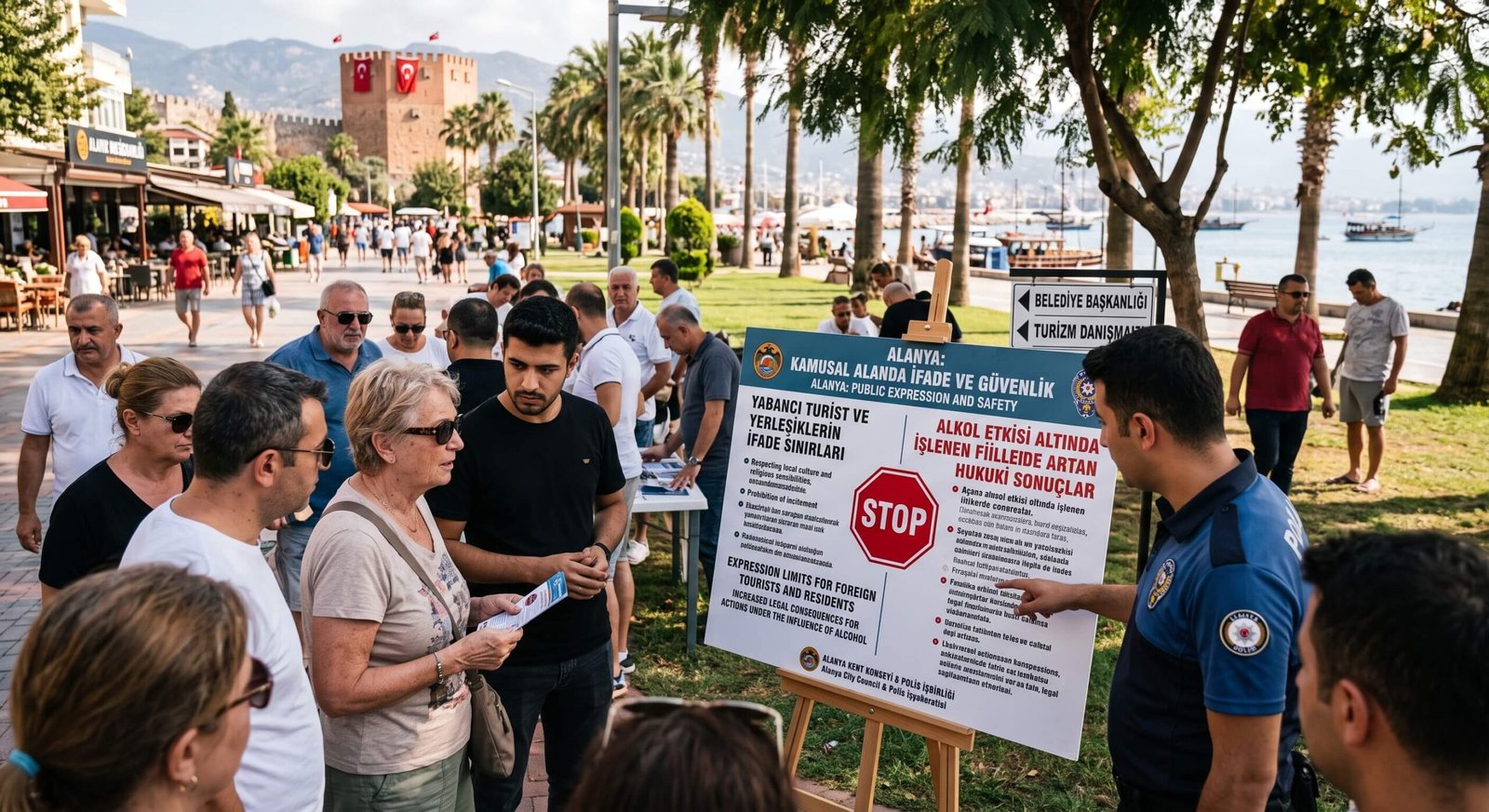
Alanya welcomes hundreds of thousands of German, Russian, British and Scandinavian tourists every year, and thousands more foreign nationals live here year-round. Most visits pass without incident. But a remark or a gesture that would barely raise an eyebrow back home can trigger a serious criminal investigation in Turkey — and that difference usually only becomes apparent after an arrest.
An incident in Konaklı in September 2026 illustrates the risk vividly. A 45-year-old tourist from Germany was alleged to have made insulting remarks about the President in a public park in the Konaklı neighbourhood. Following reports from bystanders, gendarmerie units (Konaklı Jandarma Komutanlığı) detained him quickly. He was found to be intoxicated, and the duty judge (Nöbetçi Sulh Ceza Hakimliği — roughly equivalent to an on-call magistrate) remanded him in custody on a charge of insulting the President. He was transferred to Alanya L-Type Closed Prison. The criminal investigation is ongoing; no conviction has been entered and the presumption of innocence applies.
This article covers the high-risk legal areas that foreign visitors and residents in Alanya most commonly encounter: speech-related offences, the legal consequences of alcohol, the additional administrative consequences specific to foreign nationals, and the rights you have if you are taken into police custody.
Insulting the President in Turkey: the Turkish Penal Code (TCK) Art. 299
In Turkey, insulting someone is not merely a civil matter giving rise to compensation — it is a criminal offence carrying a potential prison sentence. Insulting the President is among the most serious forms.
Art. 299 of the Turkish Penal Code (TCK) provides as follows. Anyone who insults the President faces one to four years’ imprisonment. If the offence is committed in public, the sentence is increased by one-sixth. Prosecution requires the consent of the Minister of Justice.
Several aspects of this provision are particularly significant for foreign visitors.
The “public” threshold is easily met. Any setting where others can hear — a park, a beach, a restaurant, a hotel lobby or public transport — can satisfy the public element. In the Konaklı case, the fact that the words were spoken in a public park and reported by bystanders was decisive.
The language you use is irrelevant. Words spoken in German, Russian or English can still found a criminal charge. In Alanya especially, hotel staff, shopkeepers and fellow tourists who understand these languages are plentiful — the chances of someone reporting you are real.
Social media is covered too. Posts, comments and even content shared in messaging groups while you are in Turkey can be investigated.
Foreign nationals face a higher risk of remand in custody. Having no fixed address in Turkey is frequently cited as grounds for a “flight risk” under Art. 100 of the Code of Criminal Procedure (CMK). Even if the court imposes judicial supervision (adli kontrol) rather than remand, that supervision typically takes the form of a travel ban. In practice, your return flight becomes worthless and you may be stuck in Turkey for months.
A contested provision
TCK Art. 299 has been the subject of sustained criticism both within Turkey and internationally. The Constitutional Court upheld it in 2016. The Council of Europe’s Venice Commission, in the same year, recommended its repeal. The European Court of Human Rights held in Vedat Şorli v. Turkey (2021) that a conviction under the provision violated the right to freedom of expression. The article nevertheless remains in force and is actively applied. Our practical advice is straightforward: whatever the legal debate, it is the law on the ground that determines your risk.
Limits on Public Expression for Foreign Nationals
Insulting the President is not the only speech-related offence you need to be aware of. Several other provisions catch foreign visitors off guard.
General insult (TCK Art. 125): Insulting any person carries three months to two years’ imprisonment or a judicial fine. Where the insult is directed at a public official — a police officer, gendarmerie officer or municipal enforcement officer (zabıta) — because of their duties, the minimum sentence cannot be less than one year. A single abusive word in the heat of an argument with an officer can cross this threshold.
Desecrating national symbols (TCK Art. 300): Publicly tearing, burning or otherwise desecrating the Turkish flag carries one to three years’ imprisonment. Desecrating the national anthem falls under the same provision.
Denigrating the Turkish nation and state institutions (TCK Art. 301): Publicly denigrating the Turkish Nation or state institutions carries six months to two years’ imprisonment. Prosecution again requires the consent of the Minister of Justice.
Insulting the memory of Atatürk (Law No. 5816): Publicly insulting the memory of Atatürk or damaging statues erected in his honour carries one to three years’ imprisonment, with an increased sentence if the offence is committed in a group or in a public place. Atatürk statues and busts stand in many squares across Alanya. Climbing on them, posing for “funny” photographs, or sharing such images online can have serious legal consequences.
Inciting hatred or denigrating religious values (TCK Art. 216/3): Publicly denigrating the religious values held by a section of society, where the conduct is capable of disturbing public order, carries six months to one year’s imprisonment.
The practical rule is simple: avoid making public comments — in person or on social media — about political leaders, state symbols, Atatürk or religion, especially after drinking.
Alcohol: It Doesn’t Reduce Criminal Liability — It Increases Your Risk
As the Konaklı case shows, alcohol is a factor in a large proportion of criminal cases involving foreign nationals. Many visitors assume that being drunk is some form of mitigating circumstance. Under Turkish law, it is not.
TCK Art. 34 is unambiguous: where a person commits an offence under the influence of alcohol they have voluntarily consumed, the provisions that eliminate or reduce criminal liability do not apply. “I was drunk and don’t remember what I said” is not a defence that reduces your sentence.
The offences most commonly linked to alcohol include the following.
Affray and assault: Arguments in bars and nightlife venues can escalate into intentional bodily harm under TCK Art. 86, which carries a custodial sentence depending on the severity of the injury.
Resisting or assaulting an officer: Physically resisting a police or gendarmerie officer constitutes the offence of resisting a public official under TCK Art. 265, carrying six months to three years’ imprisonment. This charge is frequently accompanied by a charge of insulting the officer.
Drink-driving: The legal blood-alcohol limit for private vehicle drivers is 0.50 mg/ml. Exceeding it results in licence revocation and an administrative fine. If a person is in a state where they are incapable of driving safely, the offence of endangering road safety under TCK Art. 179/3 comes into play, carrying three months to two years’ imprisonment. Tourists on hired motorcycles and scooters are subject to the same rules.
Disturbing public order: Causing a nuisance to others through drunken behaviour is a regulatory offence under Art. 35 of the Minor Offences Act (Kabahatler Kanunu), carrying an administrative fine.
Additional Consequences for Foreign Nationals: Deportation and Entry Bans
For a foreign national, a criminal investigation means more than the risk of imprisonment. Under the Law on Foreigners and International Protection — Law No. 6458 (YUKK), the following administrative consequences can arise.
Deportation (YUKK Art. 54): A deportation order can be issued against a foreign national assessed as posing a threat to public order or security.
Entry ban (YUKK Art. 9): A deported foreign national may be subject to an entry ban preventing them from returning to Turkey for a specified period. For those who own property in Alanya or hold a residence permit, the consequences can be particularly severe.
Administrative detention (YUKK Art. 57): While deportation proceedings are under way, a foreign national may be held in an administrative detention (removal) centre.
Impact on residence permits: Those holding a long-term residence permit or a short-term residence permit based on property ownership may encounter problems when renewing their permit.
This is why criminal defence for a foreign national must always be handled alongside the immigration law dimension. A decision in the criminal file can have a direct knock-on effect on proceedings at the Directorate of Migration Management (Göç İdaresi).
If You Are Arrested: Your Rights
Being taken into police custody is stressful at the best of times — in a country whose language you do not speak, it can feel overwhelming. Turkish law grants everyone in custody, including foreign nationals, a set of fundamental rights.
The right to consular notification
Under Art. 95 of the Code of Criminal Procedure (CMK), if the person detained is a foreign national, their consulate must be notified of the detention unless the person explicitly objects in writing. This right also rests on Art. 36 of the Vienna Convention on Consular Relations (1963). Consular officers can visit detained nationals, provide a list of lawyers and help with family communication. However, a consulate cannot represent you legally, conduct your defence or intervene in decisions made by Turkish courts.
An important note for dual nationals
The person detained in the Konaklı case was widely reported to be a Turkish national living in Germany. Turkey treats its own nationals as Turkish citizens regardless of any other nationality they hold. In practice, this can restrict a foreign consulate’s right to receive notification and visit. Turkish nationals who also hold German, Dutch, Austrian or British citizenship should not assume that a foreign consulate will automatically be able to intervene — contacting a lawyer directly should be the first priority. Holders of the Mavi Kart who have formally renounced Turkish citizenship are treated as foreign nationals and are entitled to the full consular notification right.
The right to a lawyer
Under CMK Art. 149, a suspect is entitled to the assistance of one or more lawyers at every stage of the criminal investigation. If you cannot afford a lawyer, the Bar Association (Baro) can be asked to appoint one for you under CMK Art. 150. Under CMK Art. 154, a person in custody has the right to meet their lawyer at any time, in private, without anyone else present. No power of attorney (PoA) is required for this meeting.
One rule is particularly important: under CMK Art. 148/4, any statement taken by the police in the absence of a lawyer cannot be used as the basis for a conviction unless the suspect or defendant accepts it before the court.
The right to an interpreter and the right to silence
Under CMK Art. 202, a suspect who does not speak Turkish is entitled to a free interpreter. You are not required to sign any document you do not understand. Under CMK Art. 147, you have the right to remain silent. Choosing not to make a statement about the charge cannot be used against you as evidence.
How long can you be held in police custody?
Under CMK Art. 91, police custody may not exceed 24 hours from the moment of apprehension, not counting the time strictly necessary to bring you before a judge. For offences committed collectively, this period may be extended. At the end of the period you must either be released or brought before a judge.
Practical Advice for Foreign Nationals in Alanya
Avoid making public comments — in person or on social media — about political leaders, state symbols, Atatürk or religion. After drinking, steer clear of arguments and never make physical contact with law enforcement officers. Keep a copy of your passport and the contact details of a trusted lawyer with you at all times. If you are taken into custody: stay calm, ask for a lawyer, do not give a statement without an interpreter, and do not sign any document you do not understand. If you are a foreign national, ask for your consulate to be notified. If you are a dual national, contact a lawyer immediately.
Conclusion
The vast majority of criminal cases involving foreign nationals in Alanya do not arise from premeditated conduct — they grow out of a moment of anger, an ill-judged joke or a few words spoken after one drink too many. Insult offences in Turkey can carry far heavier consequences than most foreign visitors are accustomed to at home: remand in custody, a travel ban, deportation and an entry ban are all real possibilities. Speaking to an experienced lawyer in the first hours of detention is often the single most important step in determining how the case unfolds. If you need legal advice on criminal law or immigration matters as a foreign national in Alanya, please get in touch.
This article is for general information purposes only and does not constitute legal advice. Every case turns on its own facts.
Frequently Asked Questions
Answers to the questions on your mind